

Due to the different types of materials used in Greenhouse construction, their thermal conductivity and insulation properties vary. Materials with relatively high thermal conductivity conduct heat more easily.
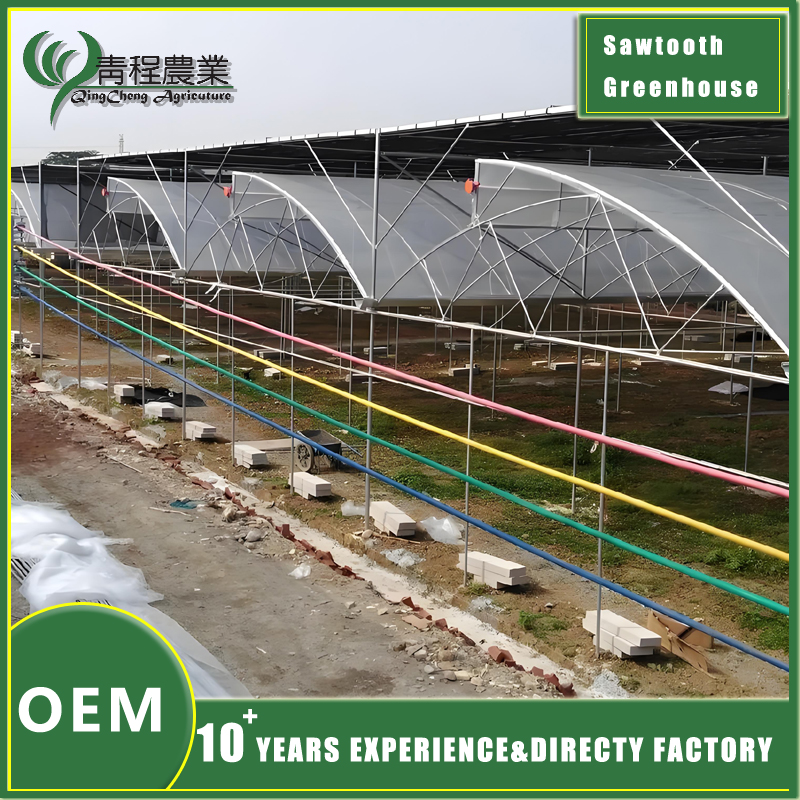
We usually refer to areas with lower insulation performance as "cold bridges." Cold bridges are the main channels for heat conduction and are also where condensation easily forms; they are weak points in insulation.
Therefore, taking measures to reduce heat loss from cold bridges is a means of energy-saving insulation for Sawtooth Greenhouse. A properly constructed Greenhouse should pay attention to the treatment of these cold bridges during construction.
Greenhouse gutters serve the function of connecting the roof and collecting rainwater for drainage. Most gutters are made of steel or alloys, with poor insulation performance and significant heat loss.
Gutters occupy less than 5% of the area in an Greenhouse, but their heat loss exceeds 9%. Therefore, the impact of gutter insulation on Greenhouse energy-saving insulation cannot be ignored.
Currently, gutter insulation methods include: one is to use hollow structural materials instead of single-layer metal materials, utilizing the air gap for insulation; the other is to attach an insulation layer to the surface of a single-layer material gutter.
Compared to brick walls, the underground ring beams and the ring beams at the top of the low walls are also areas where heat is conducted outwards. Additionally, when the wall thickness is not significant, the underground soil layer at the foundation also serves as a major channel for heat loss.
Therefore, in Sawtooth Greenhouse construction, laying an insulation layer (such as 5cm thick polystyrene foam board or 3cm thick polyurethane foam board) on the outside of the foundation and short walls is a good measure to maintain ground temperature in Greenhouse design and construction in northern regions.
For solar Sawtooth Greenhouse or vegetable greenhouses, a 0.5-1.0m deep and 0.5m wide frost-proof trench can also be dug around the Greenhouse perimeter along the foundation, filled with insulation material, to prevent ground temperature loss.